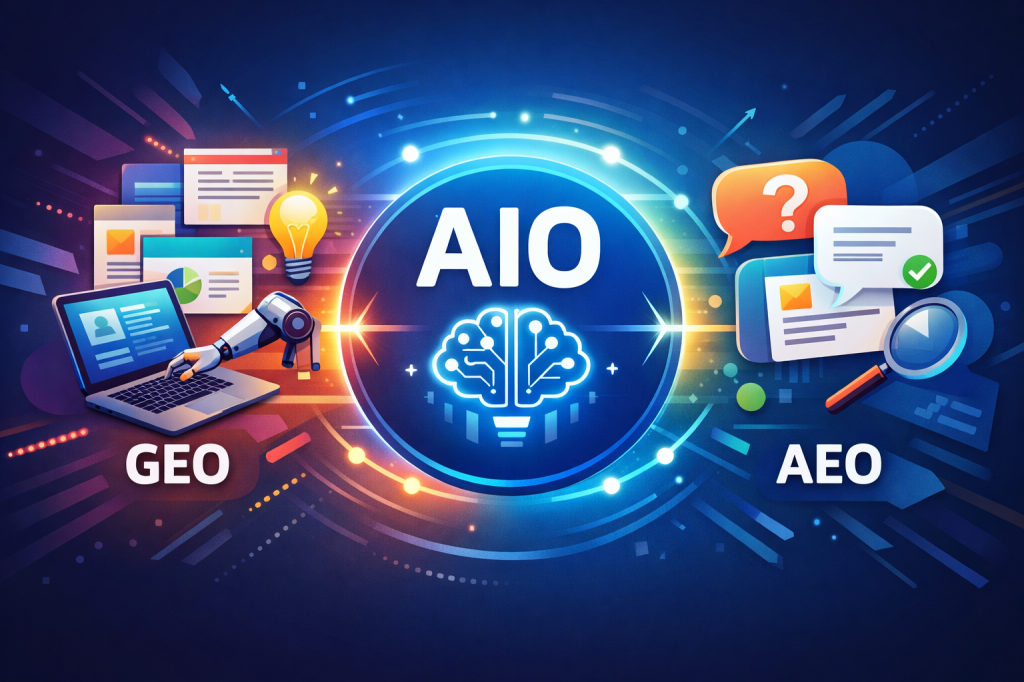
AIO, GEO, and AEO Explained: What’s the Difference and Why It Matters in 2026
For years, SEO was the main way people discovered information online. You typed something into Google, scrolled through links, clicked a website, and read. Simple.
But that world is changing fast.
Today, users ask questions directly to AI tools. They expect short, clear answers. Sometimes they don’t even see a list of websites anymore — just one generated response.
This shift has created new concepts that often get mixed up: AIO, GEO, and AEO. They are related, but they are not the same thing. Understanding the difference is crucial if you want your brand, service, or content to stay visible.
Let’s break it down — without buzzwords, without hype.
From SEO to “Answer-First” Search
Before diving into definitions, it helps to understand why these terms exist.
Search is no longer just about rankings. It’s about being selected as the source of an answer.
- Google shows AI Overviews
- Bing integrates Copilot
- ChatGPT, Claude, and Perplexity summarize the web
- Voice assistants answer instead of linking
In many cases, users never click a website at all.
That’s where AIO, GEO, and AEO come in.
AEO – Answer Engine Optimization (The Foundation)
AEO is the oldest and most practical concept of the three.
It focuses on one simple idea:
👉 How do I make my content easy to turn into a clear answer?
AEO is about structure and clarity:
- Clear questions and direct answers
- Short, well-written explanations
- FAQ sections that actually answer real user questions
- Logical headings and clean HTML
If someone asks:
“How much does SEO cost for a small business?”
AEO-optimized content gives a direct, usable answer, not a vague marketing paragraph.
What AEO is not
- It’s not about ranking #1
- It’s not about keywords stuffed everywhere
- It’s not about long, fluffy articles
AEO is the baseline. Without it, AIO and GEO don’t really work.
GEO – Generative Engine Optimization (Visibility Inside AI Models)
GEO is about being visible inside AI-generated answers.
When an AI model generates a response, it doesn’t randomly invent information. It:
- Pulls patterns from trusted sources
- Relies on consistent, high-quality signals
- Prefers content that is cited, repeated, and contextually clear
GEO focuses on making your brand and content recognizable to generative systems.
That includes:
- Consistent brand mentions across platforms
- Clear topical authority (one service = one page)
- Strong contextual signals (who you are, what you do, where you operate)
- Presence in places AI systems trust (websites, profiles, structured data)
If AEO answers questions,
GEO answers “Who should be trusted to explain this?”
AIO – AI Optimization (The Big Umbrella)
AIO is the broadest concept — and the most misunderstood.
AIO is not just content optimization. It includes:
- Website structure
- Technical performance
- Semantic clarity
- Brand consistency
- Trust signals
- Data sources AI systems rely on
Think of AIO as:
Optimizing your entire digital presence so AI systems understand, trust, and reuse your information.
This can involve:
- Clean, fast websites
- Clear service definitions
- No content cannibalization
- One clear message per page
- Alignment between website, profiles, and external mentions
AIO is strategic. It’s not a trick, and it’s not a plugin.
The Key Differences (Plain English)
| Term | Focus | Main Goal |
|---|---|---|
| AEO | Answers | Make content easy to answer questions |
| GEO | AI visibility | Be selected by generative engines |
| AIO | Whole ecosystem | Make your brand AI-understandable |
They are layers, not competitors.
You don’t “choose” one.
You build on top of each other.
Why This Matters for Small Businesses (Especially Local Ones)
Large brands already dominate traditional SEO. But AI search changes the playing field.
A small, well-structured local business can:
- Be quoted by AI answers
- Appear in voice responses
- Be recommended even without top rankings
Especially if:
- Services are clearly defined
- Location is explicit
- Content answers real client questions
- Pages don’t compete with each other
This is where AIO and GEO quietly outperform classic SEO tactics.
The Big Mistake People Make
The biggest mistake?
Treating AIO, GEO, and AEO as “hacks.”
They’re not shortcuts.
They reward:
- Clarity over volume
- Structure over tricks
- Consistency over noise
If your site is confusing for humans, it will be confusing for AI.
Final Thought
SEO is no longer just about being found.
It’s about being understood.
- AEO makes your content answer-ready
- GEO makes your brand AI-visible
- AIO connects everything into one coherent system
The businesses that win in the next years won’t shout the loudest.
They’ll explain things the clearest.
How Netwerkzone Approaches AIO, GEO, and AEO in Practice
At Netwerkzone, we work with AIO, GEO, and AEO not as buzzwords, but as practical tools for real businesses.
Instead of chasing algorithms, we focus on clarity:
clear services, clear structure, and clear answers — for both people and AI systems. That means no content cannibalization, no vague messaging, and no “one-page-for-everything” shortcuts.
Our approach combines classic SEO foundations with modern AI-ready optimization, so your website can be understood, trusted, and reused by generative engines — not just indexed.
 Netwerkzone blog
Leave a comment